Bloomberg’s Matt Levine Covers TPL

When is a shareholder meeting not a shareholder meeting?

But it’s a pretty solid polling result for Oliver, and if TPL ever does get around to holding the shareholder meeting, it seems likely that Oliver will win. So it is not clear what they gain by postponing the meeting and suing. They have a good legal argument that Oliver did not hold a valid meeting or win a valid election, but as a matter of shareholder democracy he seems to have the support of the trust’s investors, so fighting him forever is a bad look. The dissidents’ main complaint about the current board is that its governance isn’t great and it isn’t responsive to shareholders. When the board cancels and ignores a shareholder vote, that kind of makes Oliver’s point for him.

On the other hand, it’s not all that clear what Oliver would gain by winning. He’d only get one of three seats. On May 8, TPL’s two trustees sent some of the dissident shareholders an email (which was marked “privilege/confidential,” and which the dissidents promptly published, heh) saying “even if you’d prevail in the election contest, you could not achieve any of your ultimate goals without our cooperation until another vacancy opens up (and it may be another decade until that happens).” Not wrong! Perhaps the upshot here is that Oliver will be elected and will just show up to meetings to annoy the other trustees until one of them dies. It could take a while.

One of three seats and a big shining spot light.

Disdain for Shareholders Abounds

Matt Levine at Bloomberg: Carl Icahn Wants an Oxydarko Vote

Without Buffett’s money, Occidental would need to issue a lot of stock to buy Anadarko, triggering a shareholder vote under New York Stock Exchange rules; Buffett’s money, though, replaces some of the stock and allows Occidental to sneak in under the voting threshold. “This is … awkward,” I once wrote; structuring the deal to avoid a shareholder vote seemed to me like “a confession that (1) your shareholders don’t like the deal and (2) you don’t care.”

Texas Lawbook / Dallas Business Journal

Texas Pacific Land Trust proxy litigation heats up with countersuit

But in the Oliver group’s countersuit, they claimed the postponement of the meeting was only done when it became apparent that Oliver would win the election. They made public announcements that they would hold a meeting anyway, claiming they reserved the right to move forward with voting.

The dissident group held a shareholder meeting anyway on May 22 in Dallas on a different floor of the building Sidley’s Dallas offices are located, where Oliver got elected.

The Oliver group argues in their countersuit that the law does not permit TPL nor its trustees to “adjourn, postpone, or otherwise delay a shareholder vote once the vote has been scheduled; only shareholders have that power.”

They also called TPL’s lawsuit, which was filed a day before the May 22 meeting, questionable, pointing out that the allegations TPL made in its lawsuit are hardly new.

Seat + Injunction + Damages

Oliver’s Answer to Plaintiffs’ First Amended Complaint and Counterclaims OF Eric L. Oliver

Below are a few excerpts from today’s filing.  Will effort to get the whole doc linked.

From Statement of Facts section:

39. On information and belief, the incumbent trustees have caused TPL to spend upwards of $5 million of shareholder capital on this proxy contest to date. But nowhere in the Declaration of Trust are trustees vested with the authority to wage proxy contests against shareholders, or in any way utilize trust property to impose on shareholders the nominee of the incumbent trustees. The trustees do not enjoy the same broad set of powers and wide field of discretion as the directors of a modern corporation. Nothing gives the incumbent trustees the power to take actions outside of managing the trust’s property as strictly outlined in the trust documents. Because the incumbent trustees have exceeded their authority under the Declaration of Trust, they are personally liable to the trust for all the expenses they have incurred without proper authority.

50. On the morning of May 22, 2019, representatives of the incumbent trustees delivered intimidating correspondence to Mr. Oliver urging him not to attend the previously scheduled meeting. However, Mr. Oliver and dozens of shareholders arrived at the meeting location, and were properly routed by building security and personnel of TPL’s counsel to a conference facility on the fifth floor of the building. At 10:00 a.m., shareholders present in person or by proxy convened and conducted the meeting, and conducted a shareholder vote that resulted in Mr. Oliver being elected as TPL’s third trustee.17 The meeting was duly authorized and properly noticed, and the results of the shareholder vote taken at the meeting are binding and effective. As a result of the vote conducted during the May 22 shareholder meeting, Mr. Oliver has been elected as TPL’s third trustee.

Counterclaims: 

The SoftVest Plaintiffs respectfully ask the Court to enter judgment against the incumbent trustees and grant the SoftVest Plaintiffs the following relief:
1. a declaratory judgment declaring that the vote conducted at the May 22 shareholder meeting was valid and effective and that Mr. Oliver has been duly elected as TPL’s third trustee;
2. a temporary injunction and a permanent injunction—issued after notice to the incumbent trustees and a hearing—prohibiting the incumbent trustees from: (1) taking any action to fail to recognize, dispute, or interfere with the results of the May 22 shareholder vote that resulted in the election of Eric Oliver as a TPL trustee; and (2) holding any meeting, taking any other official act, or conducting any other official business on behalf of TPL without the participation of the now duly elected third trustee, Eric Oliver;
3. actual damages resulting from the incumbent trustees’ wrongful acts;
4. an order requiring the incumbent trustees to restore to TPL all sums they have caused TPL to expend wrongfully and without authority, including without limitation all sums expended in conducting the proxy contest and all sums expended on their salaries in excess of the amount authorized by the Declaration of Trust;
5. reasonable and necessary attorneys’ fees;
6. costs of suit; and
7. all other relief at law or in equity to which the SoftVest Plaintiffs may be justly entitled.


Counter-claims

HK 13D

INVESTOR GROUP FILES COUNTER-CLAIMS SEEKING TO RECOGNIZE ELECTION OF ERIC OLIVER AS TRUSTEE OF TEXAS PACIFIC LAND TRUST

Lawsuit Pursues Order Requiring Incumbent Trustees to Be Held Personally Liable for Breach of TPL Declaration of Trust and Fiduciary Duties as Trustees

Pursues Damages for Unauthorized Proxy Campaign Expenses, 5,000% Salary Increase and Undisclosed Purchase of Plane

DALLAS, May 28, 2019 – SoftVest, L.P., Horizon Kinetics LLC and ART-FGT Family Partners (the “Investor Group”), which collectively beneficially own over 25% of the outstanding shares of Texas Pacific Land Trust (NYSE: TPL), announced that they have filed counter-claims against David E. Barry and John A. Norris, III, the incumbent trustees of TPL, in the United States District Court for the Northern District of Texas.

The counter-claims seek a declaratory judgment that the vote conducted at the May 22 shareholder meeting was valid and effective, and that Mr. Eric Oliver has been overwhelmingly elected as TPL’s third trustee.  The Investor Group is also pursuing an injunction to prevent the incumbent trustees from taking action on behalf of TPL without the participation of the now duly elected third trustee, Mr. Oliver.

The Investor Group is also pursuing damages from the incumbent trustees for their wrongful acts as trustees, including the more than 5,000% raise in salary given to themselves and the recent undisclosed purchase of a private plane.  The Investor Group is also seeking restoration to TPL of the money spent by the incumbent trustees in their proxy campaign to prevent Mr. Oliver’s election, as it was outside the scope of their limited powers as trustees.  The Investor Group believes such amount may be in excess of $5 million (which includes costs of private investigators paid to intimidate Mr. Oliver, two law firms, investment bank, proxy solicitor, web designers, multiple rounds of mailings and social media ads).

The Investor Group notes that its litigation is against each of the incumbent trustees in their individual capacity because their actions in these regards are unauthorized under the TPL Declaration of Trust, in addition to being in breach of their fiduciary duties under the standards applicable in their capacities as trustees.

The Investor Group again thanks all shareholders for their support.  It is unfortunate that additional shareholder resources will have to be spent by both sides to pursue this matter in lawyers and PR advisors, but the incumbent Trustees have once again demonstrated that they will use all measures and assets at their disposal to defend their incumbency and prior actions; if history is a guide, such behavior rarely stops of its own accord and, more often, escalates.

As the unnecessary spending on each side escalates, the Investor Group again calls on David Barry and John Norris to welcome Eric Oliver as a fellow trustee, to work with him collaboratively to create value for all shareholders and to finally move forward.
 

Permian Consolidation

Occidental Petroleum: Playing The Long Game In The Permian

Good reading here.

There’s a lot of oil in the Permian

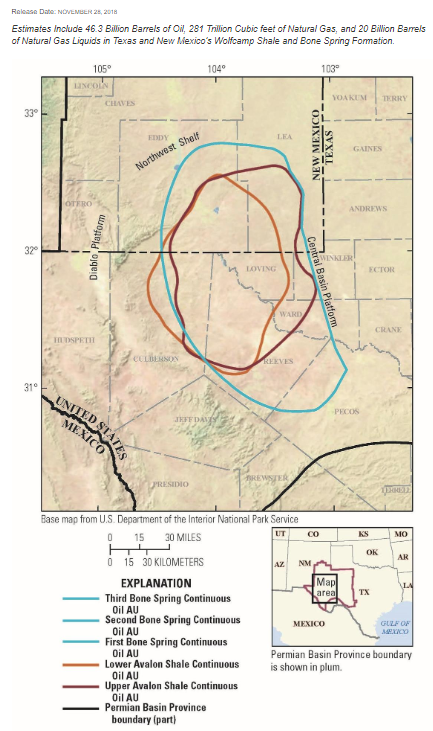
Estimates vary but the U.S.G.S. recently opined that the Permian might be expected to contain as much as 46.3 bn barrels of oil, mostly in the prolific Wolfcamp and Bone Spring reservoirs. This sometimes referred to as a “stacked play,” What this means is there are multiple reservoir horizons, stacked vertically that give oil companies multiple drilling targets. I’ve heard some estimates that go as high as 75 bn barrels, an estimate that comes from Scott Sheffield, the recently retired CEO of Pioneer Exploration, (PXD). The truth is, no one really knows, but it is generally a good sign when estimates are being raised. Nor do comparisons to Saudi Arabia hurt.

Source: USGS.gov

At present rates of extraction, about 4 mm BOEPD, that could mean that there are between 30-40 years of exploration and development remaining in the Permian. A figure that’s likely to be boosted as time goes on.