Proxy!

https://ir.stockpr.com/tpltrust/sec-filings-email/content/0001104659-21-147282/tm2134765d1_defr14a.htm

Question 7 is new. Some changes quoted below.

In addition to the addition of question #7, the other large item of note is Murray Stahl informing the board that he intends to vote against the election of Dana McGinnis. Didn’t see that one coming!

Post other observations in the comments please. What else caught your eye?

Proposal Seven: Approval of the stockholder proposal requesting that the Board take actions to declassify the Board requires the affirmative vote of a majority of the votes cast on the matter. Abstentions and broker non-votes will have no effect on the outcome of this proposal.

What is the deadline for receipt of stockholder proposals to be presented at the next annual meeting of stockholders?  In order for any stockholder proposal submitted pursuant to Rule 14a-8 promulgated under the Securities Exchange Act of 1934, as amended (the “Exchange Act”) and the Company’s bylaws, to be included in the Company’s Proxy Statement to be issued in connection with the 2022 Annual Meeting of Stockholders, such stockholder proposal must be received by the Company no later than August 8, 2022. Any such stockholder proposal submitted, including any accompanying supporting statement, may not exceed 500 words, as per Rule 14a-8(d) of the Exchange Act. Any such stockholder proposals submitted outside the processes of Rule 14a-8 promulgated under the Exchange Act, which a stockholder intends to bring forth at the Company’s 2022 annual meeting of stockholders, will be untimely unless it is received between August 31, 2022 and September 30, 2022 in accordance with our bylaws and Rule 14a-4 of the Exchange Act. Any changes to such dates will be disclosed in our periodic reports on Form 10-Q or Form 10-K, or current reports on Form 8-K, filed with the Securities and Exchange Commission (“SEC”). Any such request should be directed to the Company’s Secretary at 1700 Pacific Avenue, Suite 2900, Dallas, Texas, 75201 or (214) 969-5530.

Murray Stahl, in violation of the Stockholders’ Agreement, has informed the Company in writing on December 2, 2021 that he intends to vote against the election of Dana F. McGinnis. 

PROPOSAL SEVEN

STOCKHOLDER PROPOSAL

The following non-binding, advisory proposal was submitted by Gabriel Gliksberg, a stockholder of the Company. Mr. Gliksberg has informed the Company that his address is 538 West Stratford Place, Chicago, Illinois 60657, and that he is the beneficial owner of 100 shares of Common Stock.

“Resolved: shareholders of the Company recommend that as soon as practicable the Board of Directors take all necessary steps within its legal power and in accordance with applicable law (and subject to shareholder approval) to declassify the Board of Directors and reorganize it into one class with each director subject to election each year. Implementation of this proposal will not affect the unexpired terms of directors elected prior to the implementation of the proposal from completing the term for which such director was elected.”

SUPPORTING STATEMENT SUBMITTED BY MR. GLIKSBERG

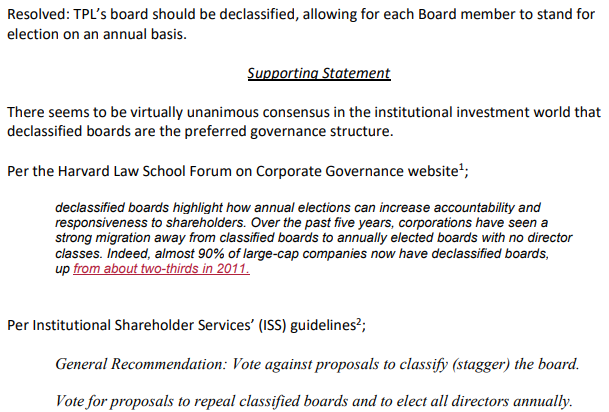
There seems to be virtually unanimous consensus in the institutional investment world that declassified boards are the preferred governance structure.

Per the Harvard law School forum on Corporate Governance website1;

declassified boards highlight how annual elections can increase accountability and responsiveness to shareholders. Over the past five years, corporations have seen a strong migration away from classified boards to annually elected boards with no director classes. Indeed, almost 90% of large-cap companies now have declassified boards, up from about two-thirds in 2011.

Per Institutional Shares Services’ (ISS) guidelines2;

General Recommendation: Vote Against proposals to classify (stagger) the board.

Vote for proposals to repeal classified boards and to elect all directors annually.

STATEMENT OF THE BOARD OF DIRECTORS RECOMMENDING A VOTE AGAINST THIS STOCKHOLDER PROPOSAL

The Board’s Nominating and Corporate Governance Committee regularly reviews the appropriate structure and composition of the Board and is committed to evaluate the classified structure with the intent to implement, contingent upon the Board’s review, a declassified board in the future. The Committee and Board will be thoughtful in their evaluations of Board structure and governance, consider input from all stockholders and the Board will share relevant changes to Board structure and governance with our stockholders as deemed appropriate.

However, especially in light of the Company’s unique circumstances, proper review must be undertaken to study the procedures required in accordance with rules and guidance from the SEC, Delaware law and the Company’s charter documents and other binding agreements. The Company is committed to beginning the process of undertaking such steps, but cannot support the stockholder proposal as submitted.

Accordingly, the Board of Directors recommends a vote AGAINST this stockholder proposal.
Dallas Business Journal Writes

https://www.bizjournals.com/dallas/news/2021/11/30/texas-pacific-land-corporate-governance.html

The company said in a prepared statement to Dallas Business Journal that its classified board structure was recommended while still a trust by the Conversion Exploration Committee. The committee was made up of trustees and investors, most of whom became board members. “The structure is intended to provide stability and continuity to ensure a smooth transition from a trust structure to a c-corporation, and to enable TPL Corporation to attract and retain highly qualified directors who have a focus on the long-term objectives of the company,” a Texas Pacific spokesperson said in a prepared statement to Business Journal.

Tim Schwartz, whose firm Schwartz Investment Counsel owns an almost-1% stake in Texas Pacific, said he was glad when the trust converted to a corporation. “I think that was a huge positive for the company,” Schwartz said. “But since then, I would say there’s been not as much progress as we would have hoped in terms of the corporate governance. And to us, it feels like the board is not that conducive to additional corporate governance improvements. The actions they’ve taken over the past few weeks, that just solidifies that opinion.”

James Spindler, the University of Texas at Austin Mark L. Hart, Jr. Endowed Chair in Corporate and Securities Law and a professor at the McCombs School of Business, said implementing a classified board like Texas Pacific’s can be controversial. Classified boards can entrench directors, protecting them from removal in hostile takeovers or proxy battles — like the one Texas Pacific faced two years ago. 

“There’s a general concern among reformers and activist investors, and I think in the larger corporate communities, that classified boards have some negative consequences,” Spindler said. “(They) tend to entrench management. So if you have management that’s making bad decisions, or making self-interested decisions, it’s a lot harder to kick them out.” Harvard Law School professors Alma Cohen and Director of the Program on Corporate Governance Lucian Bebchuk — experts on corporate governance — found through research that there’s a correlation between classified boards and “an economically meaningful reduction in firm value.”

SEC Says Maybe

We have some updates on outstanding shareholder proposals via the SEC No-Action Chart.

First, it appears as if the SEC has sided on behalf of TPL in concurring that there is basis to exclude the proposals of Special Opportunities Fund, Inc and Robert Zaccheo, Jr. 

BUT, there is some light for the Declassify-the-Board proposal of Gabriel Gliksberg. The SEC chart indicates there is a revision that could be undertaken that would, in their eyes, make the proposal ineligible for exclusion.  

ATG/Gliksberg took to Twitter to elaborate by posting the full reply from the SEC. The letter, dated 11/23, states that Gliksberg can cure the one basis for exclusion found by the SEC by modifying some language in the proposal that would allow for elected directors to not have their terms shortened should the proposal be successful. Gliksberg has a week to act.  

I don’t remember electing any directors, but that’s beside the point.  

Let’s say Gliksberg modifies the language. That gets us to 11/30. From there, the proposal gets into the new updated proxy which then goes right to the printer. Maybe it arrives in your mailbox in the second week of December? 

Come for the investment. Stay for the show. Never a dull moment.

But seriously, Happy Thanksgiving! We have much to be thankful for. (Including my poor grammar). 

They have to include it, right? 

40 Days

At the time of this writing, TPL is well inside the 40 days required for electronic proxy notification. This is not a violation of rule, however, as the company can opt to print and deliver all materials (“full set”) within a more narrow deadline.

Put the printer’s bill on the expense line I guess.

https://dart.deloitte.com/USDART/home/accounting/sec/sec-material-supplement/small-entity-compliance-guides/shareholder-choice-regarding-internet-availability-proxy

Public Call for Declassification

https://www.prnewswire.com/news-releases/texas-pacific-land-corporation-stockholder-calls-on-board-to-declassify-301426132.html

In light of the above, TPL’s current Board structure is clearly out-of-step with corporate governance best practices and the consensus policies of the public company community. What is more, the Board’s resistance to modernizing its structure by declassifying is both unexplained and, frankly, inexplicable. If the Board honestly believes as faithful corporate fiduciaries that there are good reasons for retaining its antiquated classification scheme, then one would have expected it to invite a vigorous debate with its shareholders on the question at the upcoming Annual Meeting.

Hard to argue with a call for modern governance.

Why does it have to come to this? Elliot just got two seats on DUK’s board with 0.2% ownership but we can’t vote on proposals from passionate, long term shareholders? Something isn’t right.

When will the board align itself with shareholders?

New Proposal – Declassify the Board

First, an update on two proposals of which we are aware:

Update on proposal of Special Opportunities Fund, LLC

Update on proposal of Robert J. Zaccheo, Jr

To no one’s surprise, management is pushing back on both. TPL’s team has branded both as “micromanaging”. The authors of both proposals have responded to TPL’s response. Now we wait.

Now, to the newest proposal:

Proposal of Gabriel Gliksberg

It is hard to argue against modern corporate governance standings but, predictably, TPL has found a way. Would suggest that shareholders read this proposal and management’s response in its entirety.

Takeaway:

At this point it is fair to say that TPL management holds the shareholders in very low regard. We appear to have an HBS-case-magnitude agency problem on our hands. I will respond in turn and vote no or abstain on all director and currently known proposal votes.

If you would like to follow along at home, the SEC search page is a handy tool. As are the No-Action Response List, the No-Action Response Chart, and the Incoming No-Action Response List.

BRK

“Berkshire has repurchased about 1% of its outstanding shares during each quarter in 2021. Its current market value is around $648 billion. Berkshire has repurchased $20.2 billion of stock so far in 2021 and is on pace for about $27 billion for the full year, above the $24.7 billion repurchased in 2020.”

https://www.barrons.com/articles/berkshire-hathaway-stock-price-earnings-51636202458

If you’re in a secular bull market in oil and the offer side on new assets is too high you should be shrinking the denominator, right?

3Q21 Earnings

This is why we all own it.  Clean quarter that is demonstrative of the power of the assets.  All eyes on capital return / allocation policy from here…

Summary

10-Q

Call tomorrow 8:30 eastern, 7:30 central

Edit: Below is what I wrote to a contact after the call. What was your reaction?

“I think they took a well deserved victory lap on water. Margins are turning up and that business does need active management. Using bid/ask as an excuse for keeping $400MM in cash on the sheet seems like a stretch.”

Postponed

https://ir.stockpr.com/tpltrust/sec-filings-email/content/0001104659-21-131437/tm2131356d2_defa14a.htm

On October 29, 2021, Texas Pacific Land Corporation (the “Company”) issued a press release announcing that the Board of Directors of the Company (the “Board”) has determined to postpone the 2021 Annual Meeting of Stockholders (“the 2021 Annual Meeting”) from November 16, 2021 to December 29, 2021. The Board has also fixed the close of business on November 29, 2021 as the new record date for the determination of stockholders entitled to notice of and to vote at the 2021 Annual Meeting or any adjournments thereof.

The Board decided to postpone the 2021 Annual Meeting in order to provide the Company with additional time to review and respond to stockholder proposals that have been received by the Company.

The Company filed a definitive proxy statement with the Securities and Exchange Commission (the “SEC”) on October 4, 2021 and an Amendment No. 1 to the definitive proxy statement with the SEC on October 22, 2021. The Company will be filing a second amendment to the definitive proxy statement with the SEC, which will contain information regarding the postponement.

Get off that ski lift and get yourself to Dallas.

Shrouded in Mystery

What do we know about TPL’s long term corporate strategy and capital allocation/return plans?

We’ve heard, via a research report, that management would like a stock authorization to do M&A. We’ve also seen the company hire individuals with M&A experience. What’s the direction there?

There are no shareholder proposals that pertain to acquisition strategy or capital allocation. Why not?

Do investors need better/more representation on the board?

With the three investor representatives bound by a stockholders agreement, are investors marginalized by a simple majority board vote?

Why are we still in the dark?

CS Writes Again

TPL management views an eventual share authorization as a key piece of the puzzle to position TPL as a consolidator long term. We believe management views the steps the company has taken over the past several years as setting it up to be an eventual consolidator (e.g. C-Corp conversion, new Board of Directors, enhanced operational disclosure, new accounting firm, recent hires, etc.). And that adding a share authorization is a key piece to their long-term outlook for the company. Since we initiated coverage, it has become increasingly clear that this is in direct contrast with a group of vocal long-term retail shareholders who want to see the company return to its roots (TPL was originally a liquidating trust) with a focus on continued share buyback, maximizing margins/capital efficiency, and an aversion to large-scale M&A activity. Our view is that as management fully articulates its strategic outlook, it will likely drive an accelerated shift in the investor base toward an institutional audience.

If share authorization for M&A is so important to management, why isn’t it on the proxy this year? Is it possible that the board and management aren’t aligned on this? And why does CS keep beating this drum? Who is feeding this line of thinking to CS?