Close

Recycle That Water!

UT News: Study Quantifies Potential for Water Reuse in Permian Basin Oil Production

The UT Bureau of Economic Geology led the study that highlights key differences in water use between conventional drill sites and sites that use hydraulic fracturing, which is rapidly expanding in the Permian. The study was published in Environmental Science & Technology on Sept. 6, with results indicating that recycling water produced during operations at other hydraulic fracturing sites could help reduce potential problems associated with the technology. These include the need for large upfront water use and potentially induced seismicity or earthquakes, triggered by injecting the water produced during operations back into the ground.

For conventional operations, the produced water is disposed of by injecting it into depleted conventional reservoirs, a process that maintains pressure in the reservoir and can help bring up additional oil through enhanced oil recovery. Unconventional wells generate only about a tenth of the water produced by conventional wells, but this “produced water” cannot be injected into the shales because of the low permeability of the shales. The study found that the produced water from unconventional wells is largely injected into non-oil-producing geologic formations—a practice that can increase pressure and could potentially result in induced seismicity or earthquakes.

The study points out that instead of injecting the produced water into these formations, operators could potentially reuse the water from unconventional wells to hydraulically fracture the next set of wells. Enough water is produced in the Midland and Delaware basins in the Permian to support hydraulic fracturing water use, and the water needs only minimal treatment (clean brine) to make it suitable for reuse.

Who’s got enough land to store and re-distribute vast quantities of water throughout the basin?

Below is a link to the study.  More to come from me after I dig in.

Study:  Water Issues Related to Transitioning from Conventional to Unconventional Oil Production in the Permian Basin

 

Another Good Overview (link)

Keith Schaefer: The Biggest Failure in US Shale is Also The Most Profitable

This website is very sales-y but Schaefer does a good job summarizing the basics of $TPL.


The quote below isn’t entirely correct as I’ve come to learn that Texas Pacific Water Resources (TPWR) is becoming more of a regular presence on the conference/ marketing scene and rightly so.

If you are looking to attend a Texas Pacific Land Trust session at an oil and gas conference you will be disappointed.

They won’t be there.

You aren’t going to be able to read an analyst report on this company either.  Nobody follows them since there are no investment banking fees to be earned here.

Even press releases from these guys are few and far between.  They announce quarterly earnings and that’s it.

The corporate website is functional and nothing more.


Royal Oils

Laurentian Research at Seeking Alpha: 

The Oil Royalty Companies: Get An Exposure To Rising Oil Price At Half Of The Risk

Good article here on interest types and valuations.  Great primer to understand an important part of TPL’s business.

 If buying“even slivers of royalty interests can dramatically improve the economic life of a field“, then it naturally follows that a portfolio purely of royalty interests, unblemished by cost-burdened working interests, is supposed to deliver superior economics. If you can have all the good stuff, nothing but the good stuff, why bother to own the inferior stuff? The good stuff here is the royalty interest, while the inferior stuff is the working interest.

This is where the royalty companies come in.

TPL differs from most if not all of the trust below by virtue of its surface land ownership.  Royalties are an important part of the TPL circus but they certainly aren’t the only act.

The oil royalty trusts typically produce from and gradually deplete the royalty-interest-bearing properties without asset replacement until their exhaustion. Examples of the royalty trusts include Texas Pacific Land Trust (TPL), BP Prudhoe Bay Royalty Trust (BPT), Sabine Royalty Trust (SBR), Permian Basin Royalty Trust (PBT), San Juan Basin Royalty Trust (SJT), SandRidge Permian Trust (PER), Enduro Royalty Trust (NDRO), MV Oil Trust (MVO), Pacific Coast Oil Trust (ROYT), VOC Energy Trust (VOC), Cross Timbers Royalty Trust (CRT), Chesapeake Granite Wash Trust (CHKR), North European Oil Royalty Trust (NRT), SandRidge Mississippian Trust II (SDR), SandRidge Mississippian Trust I (SDT), ECA Marcellus Trust I (ECT), Mesa Royalty Trust (MTR), Hugoton Royalty Trust (OTCQX:HGTXU), and Marine Petroleum Trust (MARPS).

The authors give TPL it’s due later in the article.   Nice of them to make an exception.

Asset durability

Fee simple mineral title and overriding royalty interest last forever, while net profit interest and volumetric production payment expire along with the underlying leasehold (see here). Perpetual ownership enhances the intrinsic value of the royalty interest immensely.

Texas Pacific Land Trust (TPL) is one of the largest landowners in Texas with 890,000 acres in the much-prized West Texas, which were previously held by the Texas and Pacific Railway Company. By retaining perpetual non-participating oil and gas royalty interests, the trust generates revenue from royalties from oil and gas and from pipeline easements and leases. The trust also generates revenue from royalties on sales of water and direct sales of water. Generally, we avoid trusts, but Texas Pacific’s sheer size makes it an exception (Fig. 7).

Fig. 7. The land holdings of Texas Pacific Land Trust

Some Color on TPL’s Royalty Interest. Go Get ‘Em $CVX!

Glenn Stehle comments at Peakoilbarrel.com

The performance of the Texas Pacific Land Trust stock certificates gives a glimpse of what investors believe is to come once Chevron begins drilling shale wells on its acreage.

The trust owns a 1/16 non-participating royalty interest under 377,777 acres of the Chevron acreage, and a 1/128 non-participating royalty interest under 85,414 acres. Most of the acreage is in the Delaware Basin, but a small part is in the Midland Basin. Another part is outside the Permian Basin.

When the Wolfbone play began in 2005 the stock certificates went from about $10 a share to about $40. But the big jump occurred in 2013 when the shale play began in the Permian Basin. Since then the stock went from $40 to $300.

So overall there has been about a 3,000% appreciation in the price of the stock over the last ten years. And Chevron hasn’t even began drilling shale wells on the acreage in any significant way yet.

Love That Dirty Water

Water is of critical importance in shale activities.  TPL happens to be sitting on ~900k acres of land from which water can be readily extracted and to which used water can be readily disposed.

Though the article doesn’t mention TPL’s newly (2017) formed water subsidiary, Texas Pacific Water Resources, my research indicates it is/will continue to be a player in the Texas/New Mexico water arena.

Not hard to envision a $300MM++ top line from TPWR one day soon.

I remind the reader that the above is conjecture.  Just personal estimates for me to get my thoughts together.  DYOR!

“Overall, the region will pull up enough water this year alone to cover all of Rhode Island nearly a foot deep. Wall Street is well aware of the threats posed by the Permian Basin’s pipeline and labor shortages, key side effects from the region’s rapid buildup. But investors “aren’t as well apprised of some of the other risks and challenges that could be just as material, if not more so,” said Gabriel Collins, a fellow in energy and the environment at Rice University

“I’d put water right at the top of that list,” he said.

How material? Spending on water management in the Permian Basin is likely to nearly double to more than $22 billion in just five years, according to industry consultant IHS Markit. The reason is twofold. The rig count is rising, and many of the “workhorse” disposal formations used for decades are starting to fill up, said Laura Capper, an industry consultant. That means explorers have to move water further to find a home for it.”

Cleaning out my closets. Another great read

Texas and Pacific Railway and Texas Pacific Land Trust – a History of Railroads in Texas

Will continue to clean out my evernote notebook dedicate to TPL and deposit here.  This is a great read.

“Texas and Pacific Railway was created by federal charter in 1871. Its charter was to build a southern transcontinental railroad between Marshall, Texas and San Diego, California. Railroad companies were given land grants in exchange for building rail line, and the U.S. Congress granted T&P twenty sections of land per mile in California and forty sections per mile through the territory that is now Arizona and New Mexico. The State of Texas (where there were no federal lands) agreed to grant T&P twenty sections per mile for the portion of the line crossing Texas. The panic of 1873 caused financial difficulties, and by 1876 only 444 miles had been built. In 1879, Jay Gould bought the company and began laying track west. Gould merged T&P with Southern Pacific Railway, and by 1881 it had built a total of 972 miles of track, entitling it to 12.4 million acres of land. But because it had not built all of the line within the time required by its charter, T&P was awarded only 5,173,120 acres, later reduced to 4,917,074 acres – 3.5 million of that in Texas.

In 1888, the T&P went through bankruptcy and receivership, and the bondholders who financed the railroad were awarded the land in Texas that had been granted to T&P. The bondholders created a trust, Texas Pacific Land Trust, to liquidate those lands for the benefit of the bondholders, receiving 3.5 million acres of land. The certificates of trust issued to the bondholders were later listed on the New York Stock Exchange. The mineral estate under the land was spun off into a separate entity and later sold to Texaco, now Chevron. TPLT owns a royalty interest in almost 500,000 acres of its land.”


Meet the Shalennials (Bloomberg)

Meet the Shalennials: CEOs Under 40 Making Millions in Texas Oil

“Glover joined Texas Pacific as a land man in 2011, the youngest person at the company by at least 15 years, he said. Texas Pacific had a market value then of just over $1 billion.
As the market woke up to the size of the company’s land holdings (a 1 million acre mix of surface and royalty rights), its value has surged to $6.4 billion to make it the best-performing major U.S. oil stock never to have pumped a barrel of crude. Glover is the chief executive officer, historically an administrative role.
“There is no way anyone could re-create an asset base like this today,” he said. “Because of the value of the land and resources we sit on now, more active management of Texas Pacific is a necessity.”

Glover did his homework and has been playing a good long game.  Historically, TPL hasn’t paid its employees much but there might be an argument to do so to keep Glover in the seat.  Unlike other employers in the area, TPL (I think!) does not have the ability to retain top talent with stock based comp.


1888 : Declaration of Trust (link to sec filing)

Declaration of Trust

FIRST. The said Charles J. Canda, Simeon J. Drake and William Strauss and the survivors and survivor of them, and their successors or successor in the trust (hereinafter, for brevity, styled “the Trustees“), shall have and exercise the management, control and ownership (both legal and equitable) of the said lands, premises and property. They shall have all the powers in respect of said property of an absolute owner, as to selling, granting, leasing, alienating, improving, encumbering or otherwise disposing of the same or of any part or parcel thereof, and they may, whenever they shall deem it necessary or advisable for the protection or benefit of the property or any part thereof, purchase other lands and premises, and when purchased such other lands and premises shall be held and managed by the said trustees under the terms and provisions of this declaration of trust in the same manner as the lands and premises hereinbefore described are held and managed.

The lands may be sold for cash, or partly for cash and partly on credit, and the trustees may, in their discretion, accept in payment, in lieu of money, certificates of proprietary interest issued under the terms hereof, at their current market price, not exceeding par, and the same when so received shall be canceled; provided, however, that nothing herein contained shall be construed to require the trustees to accept such certificates in payment for lands.

The trustees shall have power to purchase and acquire, in their discretion, any of the outstanding Income and Land Grant bonds and scrip of the Texas and Pacific Railway Company for the benefit of the trust, and they shall have full power and authority to borrow from time to time such sums of money as they shall deem necessary to enable them to purchase such bonds and scrip and also to pay taxes and other expenses connected with the trust, and to secure repayment of the sums so borrowed by a pledge or mortgage of the trust property or any part thereof. In case of such purchase or acquisition the certificate or certificates of proprietary interest under this trust representing the securities so purchased or acquired shall be canceled by the trustees, or, in their discretion, sold and disposed of for the benefit of the trust; and any and all second mortgage bonds of the Texas and Pacific Railway Company which said trustees may receive or acquire as holders of any Income and Land Grant bonds so purchased shall be held or disposed of by the trustees in their discretion for the benefit of the trust.

The trustees shall have power to employ such agents, attorneys and servants as they may think necessary and proper in the execution of their trust, and they shall not be liable for the default or misconduct or any act or omission whatsoever of any such agent, attorney or servant, provided said trustees are not guilty of willful carelessness and negligence in their selection or in providing for their selection; nor shall any of said trustees be liable for the default, negligence, misconduct or any act or omission whatsoever of any other of said trustees, but only for his own willful default, negligence or omission. The said trustees shall receive as compensation for their services, the sum of four thousand dollars per annum to be paid to the chairman and two thousand dollars per annum to be paid to each of the other two trustees.

All the powers of the trustees under this declaration of trust may be executed by a majority of the trustees. Any trustee may, by power of attorney, confer upon the other two trustees or either of them full power and authority to make, execute, acknowledge and deliver on his behalf deeds of conveyance of any of the trust property and any and all other instruments in writing relating thereto or any part thereof.


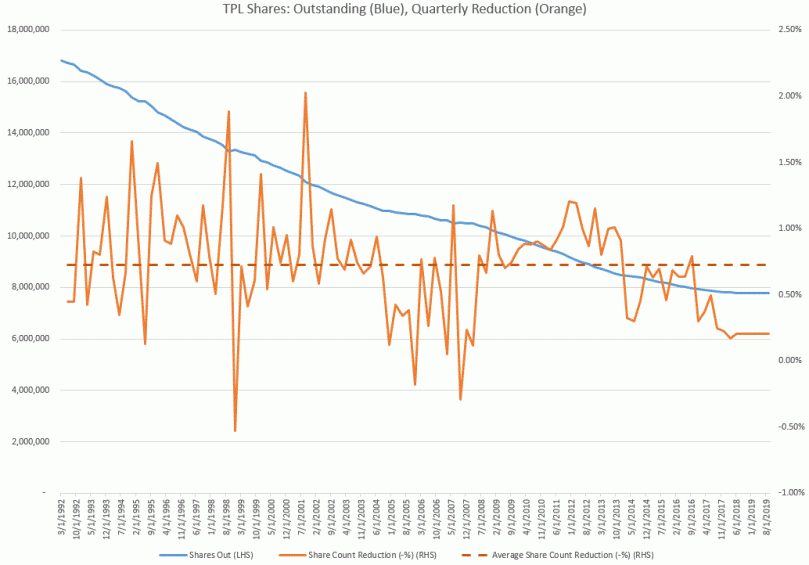
Shares repurchases declining

shares out and change

I realize I’m jumping around.  But if you know TPL, you know that it is a trust that was designed to self liquidate.  The trust generally (not always!) applies marginal free cash flow to the repurchase of shares.

As shown above, the outstanding float of shares has decreased by over 50% since 1992.  On average, the trust repurchases 0.72% of itself every quarter.  This may seem like a large number but you have to consider that the 0.72% average is applied to an ever shrinking base.

As we can see by the trend of the orange line (% shares repurchased/quarter), recent repurchases are lower than average.  Ardent followers of TPL will know that this is due to the shares simply getting more expensive.  And when I say expensive, I mean expensive outright and as a % of top line revenue and net income (more on that another day).


More early HK

Murray Stahl’s Horizon Kinetics on Texas Pacific Land Trust

“The report’s original estimation, almost 19 years ago when there were 15.4 million shares outstanding, was that by 2010, which was as far as the projection went, the share count would have shrunk to only 8.3 million. As of last September there were 8.6 million, so the model wasn’t all that far off.”

The above was written in 2014.  As of July 31 2018, there are 7,778,426 shares outstanding.

The early years : HK

Horizon Kinetics: How to Buy 1 Million Acres of Fine Texas Grazing Land for $20.00

The report linked above is from the folks at Horizon Kinetics in New York.  HK was on the TPL train early and is still a top source of information and opinion.  This 23 year old report is great resource for understanding TPL at a base level.  Of note:

“Confidence in the relative safety of this investment resides in the capacity and predilection for share repurchases by a debt-free company selling very near the value of its tangible assets. Relative to the average industrial or service company, Texas Pacific is not subject to typical competitive forces nor to marginal changes in consumer and industrial demand. It has very stable base rents and, unlike most energy companies, which must support high fixed costs, its royalty revenues are purely additive, regardless of volume. Its basic business, land and oil, are classic inflation hedges.”


Purpose

I’m going to use this space to compile resources and opinions on $TPL and relevant topics.

“Grasp the subject, the words will follow.” — Cato the Elder


Tags for search engines:
Texas Pacific Land Trust
Texas Pacific Water Resources
TPL
TPWR
Back to top