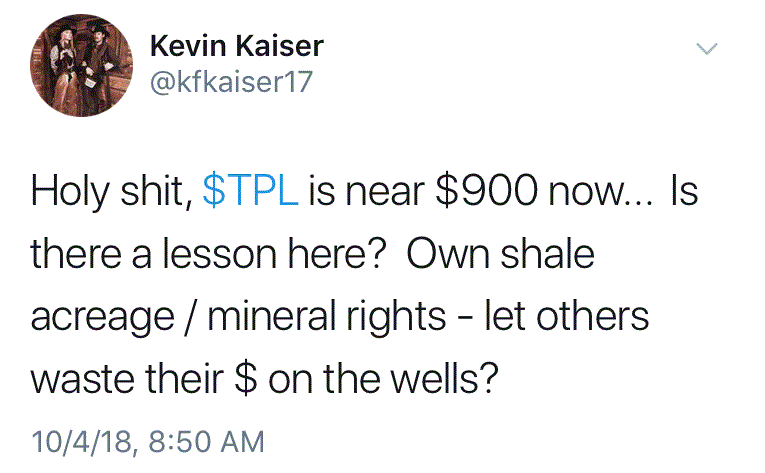
Tweet by Kevin Kaiser on Twitter
You might remember Kevin from the times he shaved 8+ figure$ off of the respective net worths of both Rich Kinder and Kelcy Warren.
You might remember Kevin from the times he shaved 8+ figure$ off of the respective net worths of both Rich Kinder and Kelcy Warren.
Sorry for two non-TPL-specific articles on the same day. It’s not my intention to turn this into an energy news blog. That said, I think this article provides a really good lay of the land for the current state and circumstances of West Texas. The area is in full boom mode and is suffering from lack of takeaway (oil transportation infrastructure) and other constraints such as rising wages, employee mobility, jammed roads, and higher general input costs.
Like 2015/2016, it is probably reasonable to assume that too much $$ will be thrown at these problems and perhaps, in the long run, the area and infrastructure could be overbuilt. The boom / bust / boom / bust “feature” of West Texas remains a key to mentally modeling and valuing the unique entity that is TPL.
Some comments from industry executives were included in the article linked above:
Pipeline and trucking constraints in the Permian Basin are hurting us now. There was a $13 per barrel price deduction for August, and I hear it may go to $20 per barrel. This, over a long period of time, is going to impact my drilling program.
We are still lacking enough qualified drivers who are able to pass motor vehicle record checks and Department of Transportation preemployment drug tests. Additionally, the market is so competitive for drivers that they will jump ship for an extra 50 cents per hour.
We saw two factors capping growth in the second quarter. The Permian pipeline capacity and discount on WTI [Midland] have slowed completions. We expect to see fewer wells completed in the second half of 2018. Many E&P companies will spend their budgets for 2018 before the end of third quarter 2018. This higher spending rate was a result of higher efficiency and higher service company prices. The net result will be a decline in total completions in the second half of 2018. We think a rebound will happen in first quarter 2019, but the Permian will continue slow growth until the pipeline capacity is increased and the WTI [Midland] discount is eliminated.

Consulting firm Arthur D. Little has released a report (trying to get my hands on it!) that forecasts some big growth in extracted BOE, wells, and related CAPEX.
The Permian, which is the top oil producing field in the United States, is producing more than 3.4 million barrels of oil a day. Growth of 3 million barrels a day by 2023 would put it near 6.5 million barrels a day, a production level above Canada, Iran and Iraq.
Summary of the report from Rigzone:
Data in the report forecasts Permian activity through the next five years to:
-Rise by up to 3 million barrels of oil equivalent per day
-Possibly produce up to 5.4 billion barrels of oil equivalent per day
-Have a need for up to 41,000 new wells (mostly unconventional) to be drilled to meet production outlook
-Require more than $300 billion in capital expenditures (CAPEX) to keep pace with growth projections
Implications for TPL are many. We have to assume some of the projected new wells will be either on mineral interest land or sundry income producing surface land. It is also reasonable to project that growth in water needs will move linearly should AD Little’s forecast come to pass. Lastly, easements for pipelines, roads, and other infrastructure would be expected to grow in number and in total contribution to top line under the scenario detailed above.
I’m seeing chatter about $30yr/EPS as being a reasonable possibility after you annualize the expectations for Q3. $30 EPS puts the trailing multiple at 29X with the stock at $864 as I type. If a doubling in production is not unreasonable (per above) then we’re looking at a 14.5X multiple on future earnings for a company with significant hidden assets.
I don’t pretend to understand all the linkages here but one can have some fun with the site above and county well records (checkout Midland) on sutlog.com.
The county roster at the bottom of the ShaleXP page linked above might be fun to reference vs this old chestnut.


I assume that most TPL-heads have seen this article but in the spirit of posting up all the resources / news / articles I find, here goes.
Kevin Crowley and David Wethe do a bang up job covering the the energy space for Bloomberg. Kevin and David are particularly strong when it comes to writing about West Texas. Be sure to give their stuff a look.
A couple notable takes from the article are below. I worry/think about both:
Glover’s pay rose almost three times to $724,000 last year, while Packer got a similar increase to $753,000, according to the annual report.
Tyler Glover and Robert Packer (TPWR) are in the catbird seat and are going to want/deserve higher comp as some point in the future. The Trust does not have a history of high pay though it seem like they are moving in that direction.
While it may have a unique history, Texas Pacific isn’t the only company making money from the Permian’s mineral leases. Diamondback Energy Inc. spun off its mineral rights into Viper Energy Partners LP in 2014. So far this year, Viper has climbed 28 percent.
Parsley Energy Inc.’s CEO last week said he’s “definitely looking into” doing something similar.
I think about bulk asset sales often. TPL could hit a bid on the the mineral rights or the water biz (and its related land) and do a massive return of capital at any time. The Trust, as designed (as far as I know) isn’t really a growth entity.
Maybe I’m way off? Let me know.
Much has changed in 4 years!
The Trust is a highly atypical company, and not only in terms of its financial performance. It manufactures no products and provides no services. It has never released a killer app or built a game-changing innovation, and it controls no patents. It maintains no factories, facilities, equipment, machinery, or inventory, nor does it carry any other meaningful expenses, aside from eight employees occupying a modest 27th-floor suite in a bland office tower in Dallas’ City Center. It has no competitors, no liabilities, and no debt. Its chief asset — land, lots of land — is finite and tends to steadily, reliably increase in value over time, that is, until someone figures out a way to suck out more oil, at which point it goes bananas.
TPL’s only real goal is to maximize returns while gradually liquidating its assets.
“Imagine the PowerPoint presentation,” muses Louis Geser, chief analyst for White Space marketing and an independent microcap analyst, who began purchasing TPL when it was around $35. “You could list what this company does on one hand, and it’s on autopilot.”
Not exactly, says David Peterson, the Trust’s CEO, who along with his team is kept pretty busy making real estate deals and keeping an eye on the accounts receivable. “It’s not as sleepy as it once was, that’s for sure, sir,” he says.
TPL stock split on 3/12/80. 3 for 1. Price was ~$135 at split. ~$45 post split.
TPL stock split on 7/13/07. 5 for 1. Price was ~$300 at split. ~$60 post split.
When do we split next? Price is way above prior split levels.
Search for $TPL on Twitter and you mostly come up with Binance lists to buy a crypto coin with the ticker TPL. But every once in a while you come up with someone who is hip to what’s going on at TPL.
This might seem mundane but I think monitoring chatter in forums, twitter, bloomberg chat rooms, etc is very important for small cap stocks.
Good and fun read here. The article presents a digestible history of oil and gas in Texas. Of note is a a great map of the original Texas & Pacific Railway line.
The record stops short of the modern fracking era. There is still much more history to be made.
During the 1970s and 1980s the Texas oil and gas industry had what might well have been its last boom. Subsequently, economic, social, and political life in the state changed greatly. The petroleum industry, more than one-quarter of the state’s economy in 1981, fell to half that level ten years later. Massive losses in energy and real estate lending brought the collapse of the large home-owned financial institutions that had commonly been at the center of community development; of the large banks, Frost National alone survived. One-third of oil and gas employment was lost between 1982 and 1994. Workers left producing regions as rigs shut down and producers carried through successive reductions in staff; white-collar ranks thinned noticeably from the late 1980s onward, as producers cut technical and managerial personnel in the face of stagnant prices and rising costs. State and local governments found that lower income from production and property taxes necessitated austere budgets, and affected communities launched searches for new revenue and increased efforts to diversify their economies. The proportion of state government revenue from the petroleum industry declined to 7 percent in 1993, one-quarter of its level ten years earlier. In the final decade of the twentieth century, a great industry and the aspects of Texas life that were related to it were downsizing. Only petrochemicals gained: lower prices for oil and gas caused facilities to expand and related employment to increase by one-tenth between 1988 and 1991. This sector of the industry remained competitive in international markets, despite pollution control and abatement costs, which approached $1 billion a year in 1994. At a rate governed by international prices and technology, the rest of the petroleum industry in Texas was inching down the road from Spindletop.
A Tontine is an investment plan for raising capital, devised in the 17th century and relatively widespread in the 18th and 19th centuries. It combines features of a group annuity and a lottery. Each subscriber pays an agreed sum into the fund, and thereafter receives an annuity. As members die, their shares devolve to the other participants, and so the value of each annuity increases.
Posts like the one above reflect the old mental model of TPL. (Though I never tire about thinking about tontines. Tontines are the investment/insurance product that that the world doesn’t know it needs.)
Anyhow, the old mental model goes like this: TPL sells land and collects miscellaneous income. Proceeds are used to repurchase and cancel shares. The guy to hold the last share out wins whatever is left.
I’d argue that the new mental model is more growth oriented: TPL is growing a water business which to me seems ripe for a spin-off (tax free!) or a sale at some point. Royalty interests are growing in value at a pace far greater than inflation (thanks technology!). Land not used for water has many uses in other oil extraction and logistics activities. The stock is painfully illiquid and hard to repurchase (thus lower repurchases). The company pays a dividend and has signaled an intention to make it regular. What we have here is an asset rich growth stock!
All signs point to liquidation and repurchase being pretty low on the priority list. Growing (top line, bottom line, capex, head count, etc) appears to be the main focus.
How are you reconciling the two? I admit to having some trouble as I worry/think about the growth trajectory/asset value tops of the land and its associated income product (though these two things are a circular value). Does TPL not do its best for the trust if it doesn’t sell all or materially all of its assets at the top? Is there a new agency problem that needs to be explored with the growth? Employees don’t want to fire themselves; the internal incentive to liquidate has to be lower. In my estimation, we’ve got a beautiful push/pull going on. It’s going to be fun watching from here on out.
Now, 130 years later, the scrub land owned by Texas Pacific Land Trust is a cash farm. Like University Lands, it makes money on mineral and surface rights. Unlike UL, it manages its water assets. Last June they formed a subsidiary called Texas Pacific Water Resources (TPWR). They have since grown from 2 employees to 52 and generated $25 million in 2017. Water revenue came in from selling brackish water (>1,000 mg/L TDS). They do not sell fresh water for fracking because they want to maintain an environmental and social conscience. They gather, treat, recycle and dispose of produced water. They track water, perform analytics and offer well testing services.
There is no use of the word “conscience” in the 10k or annual report.
Makes me wonder about the profitability of fresh water sales.
I’m trying not to read too much into this, but it is notable that TPWR and TPL employees are in different locations with the water folks based in Midland and the “corporate” folks based in Dallas.
Additionally, TWPR has it own page on Linkedin that is a separate entity from the TPL corporate office page. Only Tyler Glover (as far as I can tell) is listed in both directories.
While looking at these pages, it is worth noting that both units have been staffing up which is a departure from TPL’s old spending patterns but could be indicative of growth to come.
The UT Bureau of Economic Geology led the study that highlights key differences in water use between conventional drill sites and sites that use hydraulic fracturing, which is rapidly expanding in the Permian. The study was published in Environmental Science & Technology on Sept. 6, with results indicating that recycling water produced during operations at other hydraulic fracturing sites could help reduce potential problems associated with the technology. These include the need for large upfront water use and potentially induced seismicity or earthquakes, triggered by injecting the water produced during operations back into the ground.
For conventional operations, the produced water is disposed of by injecting it into depleted conventional reservoirs, a process that maintains pressure in the reservoir and can help bring up additional oil through enhanced oil recovery. Unconventional wells generate only about a tenth of the water produced by conventional wells, but this “produced water” cannot be injected into the shales because of the low permeability of the shales. The study found that the produced water from unconventional wells is largely injected into non-oil-producing geologic formations—a practice that can increase pressure and could potentially result in induced seismicity or earthquakes.
The study points out that instead of injecting the produced water into these formations, operators could potentially reuse the water from unconventional wells to hydraulically fracture the next set of wells. Enough water is produced in the Midland and Delaware basins in the Permian to support hydraulic fracturing water use, and the water needs only minimal treatment (clean brine) to make it suitable for reuse.
Who’s got enough land to store and re-distribute vast quantities of water throughout the basin?
Below is a link to the study. More to come from me after I dig in.


 The Texas Pacific Land Trust Investor