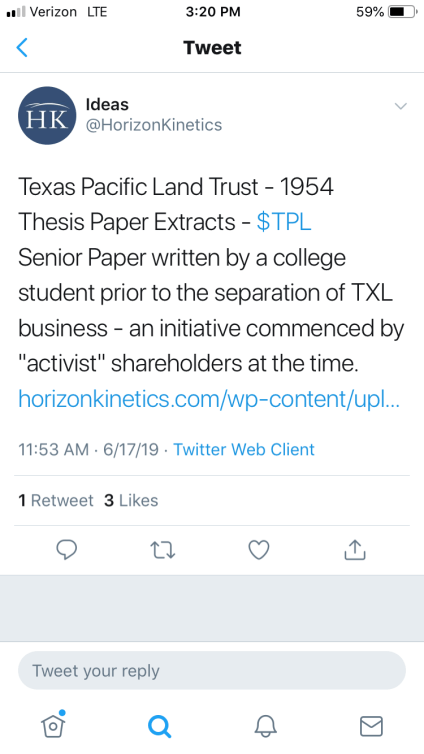
Link
Haven’t had time to read this yet but I’m looking forward to doing so.
Strongly worded letter here. There is a material probability that this could all go very south for the Trustees. That said, Trustee actions have defied logic for months now. My guess is that these guys are far away from resolution.
Eric Oliver has been elected as TPL’s third Trustee, and you are required to recognize him as such. Given your utter disregard of your basic contractual and fiduciary obligations as trustees under the TPL declaration of trust, and the excesses you have engaged in as it relates to your power and authority under such document, we intend to hold you personally liable for your actions.
With each further action you take from this point on to prevent Eric Oliver from undertaking his responsibilities as Trustee, you are creating incremental personal liability for yourselves. All the wasteful expenses you are incurring—purportedly on behalf of the Trust—will be reimbursed by you to TPL’s beneficiaries.
Since the Trust had previously announced that the meeting would be delayed until June 6, millions of shares had not even been voted at the time the Dissident Group decided to hold its sham “meeting” on May 22, 2019 – apparently the Dissident Group had no qualms disenfranchising these shareholders. The Dissident Group failed to mention that a clear majority of the non-Dissident Group shareholders had submitted proxies to elect General Cook at that point; this may explain why the Dissident Group wanted to cut the election short and not wait for the remaining millions of shares to get voted.
Let’s have another meeting then. Oh, right.
We remind all shareholders that they have rights under the declaration of trust, including the power under article Four, to inspect the books of the Trust. Two weeks ago, SoftVest delivered to TPL a demand to inspect certain records that we believe all shareholders are entitled to review under the declaration of trust. However, we have yet to receive a single requested document. What are Mr. Barry and Mr. Norris trying to hide?
We encourage all shareholders to review our demand and submit their own demand directly to Trustee David Barry (DBarry@KelleyDrye.com), with copy to Robert Packer (Robert@tpltrust.com). We invite shareholders to use our form if they deem the information we requested to also be important to them. Shareholders might also want to ask whether the votes included in Mr. Barry’s total when he was “elected” trustee in 2017 improperly included broker non-votes.
Highlighting not mine. Do we take this as evidence that negotiations aren’t going well? I wonder why?
I don’t recall having read about the broker non-vote issue in prior White card releases. Will do some digging though the cut and paste below from the link directly above would suggest that broker non-votes shouldn’t be applied to Trustee elections.
In short, a stockholder does not actually vote by proxy at a stockholders meeting, but rather instructs the broker how to vote. Sometimes, the broker can vote those shares even if it doesn’t receive any instruction from the beneficial owner. Under stock exchange rules, banks, brokers and other holders of record who hold shares of stock in “street name” for a beneficial owner of those shares, as described above, typically have the authority to vote in their discretion on “routine” proposals when they have not received instructions from beneficial owners. Such record holders, however, are not allowed to exercise their voting discretion with respect to the approval of matters determined to be “non-routine.”
For your convenience:
Texas Pacific Land Trust
1700 Pacific Ave., Ste.2770
Dallas, TX 7520l
Reference is made to the Declaration of Trust of Texas Pacific Land Trust, dated February 1, 1888, by Charles J. Canda, Simeon J. Drake and William Strauss (the “Declaration of Trust”). Article Fourth of said Declaration of Trust demands that the trustees cause books to be kept showing all “matters relating to the financial affairs and business of the trust… .” Article Fourth of the Declaration of Trust further demands that such books be open to inspection of the registered certificate holders.
Based on the foregoing, we hereby demand that you immediately make available….
- Laterals lengthen to reach more rock and hydrocarbons. For example, in the Utica Shale of the Appalachia region, lateral lengths almost doubled to 8,628 ft during 2011–2017, according to DrillingInfo data. In the Williston Basin, the average lateral now stretches more than 2 miles with a limited surface footprint thanks in part to North Dakota setting the standard drilling and spacing unit at 1,280 acres.
- Proppant and fluid volumes grow to new heights. During 2010–2017, average proppant mass spiked to 1,600 lb/ft from 500 lb/ft, and fluid volumes increased to 33 bbl/ft from 13 bbl/ft. Operators are shattering basin records, Weijers et al. noted, with some wells taking in a proppant mass equivalent to a 100-car unit train, surpassing 20 million lbs/well. This has come with the increased use of high-viscosity friction reducers.
- Stage count and intensity boom. The average stage count has risen to 40 stages/well, with average stage spacing dropping to 200 ft/stage in 2017 from 350 ft/stage in 2010.
- Pump rates take off. The rate per lateral foot increased to 0.42 bpm/ft in 2017 from 0.16 bpm/ft in 2010 in an effort to improve diversion, accompanied by a rapid increase in frac fleet horsepower.
During the downturn, operators tweaked designs to incorporate cheaper sand and lower gel loadings with cheaper fluid systems. The impact on D&C spending was dramatic. Citing data from Coras Research, Weijers et al. noted that the average well cost in four major US liquids-rich basins fell to $5.1 million in 2017 from $7.2 million in 2012. The average cost per barrel of oil produced—meaning all D&C costs for barrels in the first year of production—was just $46/bbl in 2017, compared with $128/bbl in 2012.
In simple terms, the EIA counts production, exports, imports, change in storage and refinery usage. This should pick up every barrel of oil moving through the U.S. It must frustrate the EIA’s number crunchers that the figures never foot, so they use a balancing item which used to be called “Unaccounted for Crude Oil”, nowadays simply the Adjustment. Since June 2018, the Adjustment has almost tripled.
Undercounting crude oil production seems the most likely explanation. If so, this would reinforce a couple of important themes:
1) The U.S. continues to gain market share in world energy markets
2) Growing volumes even with moderate pricing defy those who argue that much of our shale activity is unprofitable
Oil and gas production continue to surprise to the upside, which can only be good for midstream energy infrastructure.
Came across a couple new ones yesterday:
http://www.oddballstocks.com/2019/06/activism-story-texas-pacific-land-trust.html
The Texas Pacific Land Trust was created in 1888 as a liquidating trust. The trustees of this trust have but one job: liquidate it in order to pay off the bondholders who created the trust. These bondholders (and their heirs and the persons they have long since sold their rights to) are the real owners of those 7,683 square miles of what was once desert scrubland (until the Permian Basin burst on the scene as the biggest oil and gas-producing region in the country.)
We must not lose sight of this fact, no matter the slings, arrows, brickbats, and mud that is being thrown in the current proxy fight: the trust was designed to liquidate its assets in order to pay off the bondholders who organized the trust. The bondholders created the Trust and converted their bonds to “shares of proprietary interest” in the Trust, making their rights more liquid via these shares. TPL is now the second-oldest “stock” on the NYSE.
I might be displaying my ignorance here but does anyone have a document/reference that proves the above to be a FACT? The Declaration of Trust isn’t super clear on this subject.
https://www.pacermonitor.com/public/case/28272476/Texas_Pacific_Land_Trust_et_al_v_Oliver
STATUS REPORT ORDER: Lead counsel for each party (or a designee attorney with appropriate authority) must meet face-to-face at a mutually agreeable location, and no later than seven (7) calendar days before the Joint Status Report due date. Status Report due by 6/21/2019. (Ordered by Judge Jane J. Boyle on 5/31/2019)
But it’s a pretty solid polling result for Oliver, and if TPL ever does get around to holding the shareholder meeting, it seems likely that Oliver will win. So it is not clear what they gain by postponing the meeting and suing. They have a good legal argument that Oliver did not hold a valid meeting or win a valid election, but as a matter of shareholder democracy he seems to have the support of the trust’s investors, so fighting him forever is a bad look. The dissidents’ main complaint about the current board is that its governance isn’t great and it isn’t responsive to shareholders. When the board cancels and ignores a shareholder vote, that kind of makes Oliver’s point for him.
On the other hand, it’s not all that clear what Oliver would gain by winning. He’d only get one of three seats. On May 8, TPL’s two trustees sent some of the dissident shareholders an email (which was marked “privilege/confidential,” and which the dissidents promptly published, heh) saying “even if you’d prevail in the election contest, you could not achieve any of your ultimate goals without our cooperation until another vacancy opens up (and it may be another decade until that happens).” Not wrong! Perhaps the upshot here is that Oliver will be elected and will just show up to meetings to annoy the other trustees until one of them dies. It could take a while.
One of three seats and a big shining spot light.
HK continues to buy daily. All quiet otherwise.
 The Texas Pacific Land Trust Investor