Trustee Alternate

EDGAR: 14A

All EDGAR

From time to time the Reporting Persons have engaged with the trustees and other representatives of TPL, investors and other industry participants to discuss various opportunities to maximize the value of TPL for the benefit of holders of Shares. Such discussions have included (1) the conversion of TPL into a Delaware corporation subject to modern governance principles, as permitted by TPL’s declaration of trust, (2) focusing on the establishment of an experienced team around TPL’s new water business, with clearly defined goals and objectives, or otherwise considering the separation or sale of such business to a third party with a retained royalty, and (3) the addition of Mr. Oliver as a trustee of TPL. The Reporting Persons believe that the trustees of TPL should fully explore these options, as well as any other opportunities available to maximize value for holders of Shares. In addition, the Reporting Persons believe that the Trust should be more transparent and frequent on its updates to holders of Securities (e.g. drilling updates, drilled and uncompleted well updates, water production, water injection volumes, and engineering reports).

Eric Oliver

Allan Tessler


XOM Shooting for $15

Bloomberg: Exxon Aims for $15-a-Barrel Costs in Giant Permian Operation

If I had a nickel for every XOM/Permian story published this week I’d have at least a buck.

Development, operating and land acquisition costs will be “in and around $15 a barrel,” he said on the sidelines of the CERAWeek Conference by IHS Markit in Houston. West Texas Intermediate futures traded at almost $59 on Thursday. “The way we are approaching it is very unique compared to most, if not really everybody out there, as far as the scale,” he said.

Exxon plans to deploy 55 rigs in the Permian this year, by far the most of any driller, as it aims to increase output in the region fivefold to about 1 million barrels a day by 2024. Its strategy also includes building its own takeaway infrastructure from separation tanks to pipelines, and it’s even joining a giant conduit project to make sure its oil doesn’t get stuck in bottlenecks that have depressed prices in West Texas.

Exxon’s Permian expansion pits it against U.S. rival Chevron Corp., which is also aiming for strong growth there. The San Ramon, California-based company announced plans last week for 900,000 barrels a day by 2023. Royal Dutch Shell Plc is “actively looking” for deals to bulk up its Permian operations, Wael Sawan, the company’s upstream director-in-waiting said this week. Even so, its production will increase about 30 percent a year.

Water Heating Up

Chron: University Lands to expand water services in the Permian Basin

The state-owned mineral leasing and royalty company University Lands is expanding its water services in West Texas as water becomes a multibillion dollar business in the arid Permian Basin

University Lands,which also manages water rights on state lands, recently signed a deal with Fountain Quail Energy Services of Irving for a number of water-related services in the Andrews County, said University Lands CEO Mark Houser.

University Lands manages the mineral, surface and water rights for 2.1 million acres of land in West Texas with the proceeds going to the Permanent University Fund, or PUF. Founded in 1876, the fund supports both The University of Texas System and the Texas A&M University System. PUF received more than $1 billion of income from mineral rights during fiscal year 2018, state figures show.

University Lands’ concern for conserving water is part of the reason that it awarded the water management contract to Fountain Quail, which has a particular expertise in oilfield water recycling.

Fountain Quail deployed the first prototype of its water recycling technology in the Barnett Shale of North Texas in 2004. The company offers water recycling equipment that can be installed permanently at a busy site as well as a mobile version that can be moved from site to site.

May Meeting / Evolving Governance

I’m inviting blog readers to share their thoughts on the topics of TPL’s 1) evolving governance and 2) evolving capital deployment strategy.

As a baseline, we’re used to land sales, royalty collections, and cancelled shares.  Recent events have brought us significant CAPEX, reduced share repurchases, and management changes.

I’m sensing that there are many different viewpoints on the issues above.  Thinking out loud, it may be possible to come up with a rough investor consensus that could be used by management to align expectations with reality.

For instance, if there is a clear preference for buybacks over dividends, it might make sense to formally communicate that.

My dream is to cut off any agency problems before they grow.

Maybe I’m crazy.

Email me if you’d prefer to stay out of the comment section.


Tact and Discipline

WSJ: Second Wave of U.S. Shale Revolution Is Coming, Says IEA

Not high on the Texas oilman’s trait list.   Don’t give away the store fellas.


Shale was largely behind the glut of American oil that flooded the market more than four years ago, leading oil prices to fall to $30 a barrel from more than a $100 a barrel in late 2014.

U.S. shale production in 2018 grew faster than it did during the boom years of 2011 to 2014, the IEA said last year.

The U.S. last year surpassed Russia and Saudi Arabia to become the world’s largest producer of crude oil, with output currently hovering around 12 million barrels a day.

U.S. crude production is expected to rise to 13.7 million barrels a day by the end of its five-year forecast period, the IEA said Monday.

“Annual gains will boost the U.S. to levels never seen in any country, in excess of maximum capacity in both Russia and Saudi Arabia,” the report noted.

Ex-Div Date is 3/7

Holders that go to bed tonight owning the stock for 3/8 settlement or before will get paid the div.

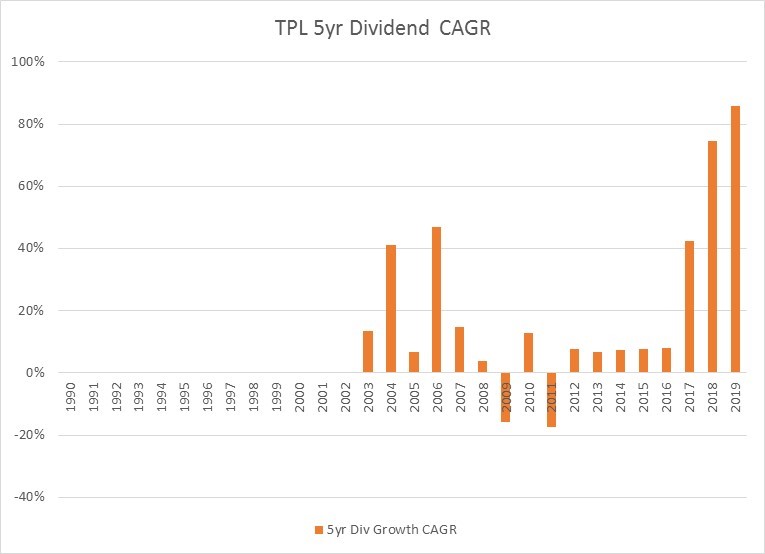
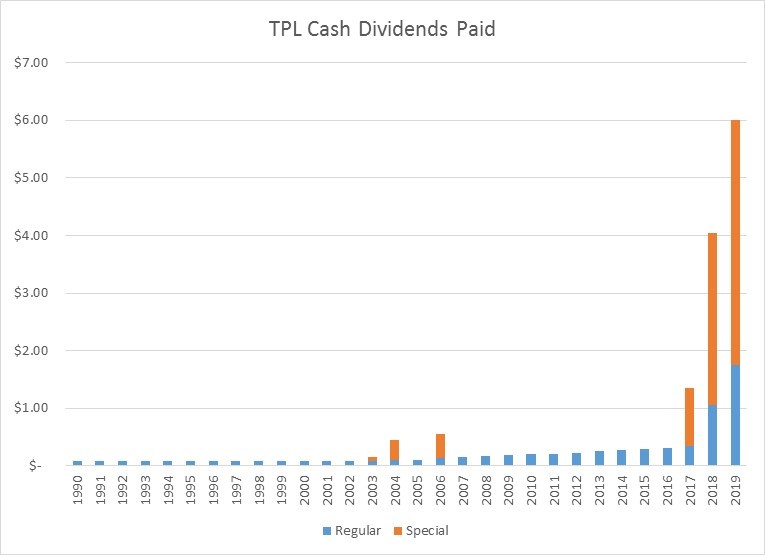
The total $6 div on the current market price of $740 get us to a div yield of 0.81%.

divs paid

Div Yield

divs cagr


A Tortoise Named Chevron

WSJ: Chevron, Exxon Mobil Tighten Their Grip on Fracking

In the next five years, Chevron expects to more than double its production in the Permian Basin in Texas and New Mexico to 900,000 barrels of oil and gas a day, the company announced at an investor event Tuesday. That’s a nearly 40% increase from its previous forecast.

“The shale game has become a scale game,” Chevron Chief Executive Mike Wirth said in an interview. “The race doesn’t go to the one who gets out of the starting blocks the fastest. The race goes to the one who steadily builds the strongest machine.”

Not to be outdone, Exxon on Tuesday announced plans to increase its Permian output to 1 million barrels of oil and gas a day by as early as 2024, a day before it was expected to disclose growth at its own investor meeting Wednesday. BP PLC,Royal Dutch Shell PLC and Occidental Petroleum Corp. are also focusing on the region.

Five years ago, Exxon, Chevron, BP, Shell and Occidental collectively made up about 9% of crude production from modern fracking techniques in the Permian. In October, the latest period for which relevant figures are available, they made up about 16%, according to data on ShaleProfile, an industry analytics platform.

Meanwhile, the big companies are just getting started. Exxon is now the largest operator in the Permian, with almost 50 rigs. The company estimates its Permian wells can generate a 10% rate of return at an oil price of $35 a barrel. While many companies reduced fracking activity in the fourth quarter of last year, Exxon increased it significantly to over 80 wells, more than double the total in the fourth quarter of 2017, according to Rystad Energy.

Chevron is raising its production guidance to 900,000 barrels of oil and gas a day by 2023. Last year, it predicted 650,000 barrels a day by 2023. The company is boosting production without adding to its rig count, a testament to how size can lead to greater efficiencies.

Chevron employed what could be described as a tortoise-and-hare strategy in the Permian. While smaller companies at times paid more than $40,000 an acre to gain rights to prime drilling opportunities, Chevron held on to land it already owned in the region, which decades ago was one of the world’s biggest traditional oil fields, without having to join in the buying frenzy.

Couple more similar articles:

https://www.bloomberg.com/news/articles/2019-03-06/exxon-targets-32-billion-in-annual-spending-on-drilling-plants

‘Society needs us to make these investments,’ Woods says

https://www.bloomberg.com/news/articles/2019-03-05/exxon-plans-massive-permian-growth-to-offset-international-drops

Within hours of each other on Tuesday, the two largest energy companies in America announced they want to pump almost 2 million barrels a day combined in the Permian Basin of west Texas and New Mexico, a higher amount than most OPEC nations. Chevron plans to reach 900,000 barrels a day by 2023, while Exxon aims for 1 million by 2024.

“Our position in the Permian just continues to get better and underpins our resource base,” Chevron Chief Executive Officer Mike Wirth said in New York. The value of the company’s Permian position has doubled over the past two years with reserve additions, he said.

New Trustee

EDGAR: 8-K

The trustees of Texas Pacific Land Trust (the “Trust”) have nominated Preston Young for election as a trustee to fill the vacancy created by the resignation of Maurice Meyer III. Mr. Young is a Regional Managing Partner for Stream Realty Partners in Houston, Texas. In accordance with the Declaration of Trust that governs the Trust, the Trust will call a special meeting of holders of sub-share certificates of the Trust, to be held in Dallas, Texas, on May 8, 2019. The Trust is in the process of preparing proxy materials for the special meeting, which will be mailed to holders of record as of March 28, 2019.

Meet Preston

Preston Young serves as Regional Managing Partner for Stream where he jointly spearheads the firm’s strategic initiatives across its existing platform and markets identified for future expansion. In addition, he oversees the firm’s initiatives concerning asset management, acquisition and development activities for its principal and strategic clients.

Mr. Young also leads the firm’s Houston office, where the service and principal portfolio exceeds 42.0 million square feet, thereby positioning Stream as one of Houston’s leading commercial real estate organizations. During his tenure, Stream has consistently been ranked as one of the “Best Places to Work” by the Houston Business Journal and “Top Workplaces” by the Houston Chronicle.

Mr. Young serves as Chairman of the Board for the St. John Paul II Foundation for Life and Family. Additionally, he is a member of the Board of Trustees for the Free Enterprise Institute and is on the Board of Directors for both the Business Ethics Forum and Catholic Charities of the Archdiocese of Galveston-Houston. At Texas A&M University, Mr. Young serves as an Advisory Board Member for Mays Business School and is a member of the 12th Man Foundation’s Champions Council.

Before joining Stream, Mr. Young served in the capital markets division at Trammell Crow Company.

That happened fast.  Guessing he was waiting in the wings.  Go get ’em Preston!

The Parent-Child Problem

WSJ: Shale Companies, Adding Ever More Wells, Threaten Future of U.S. Oil Boom

Good read on technology and science at play in the Permian.  This is a reminder that a great deal of what is happening (in my estimation) is still experimental.

Known in the industry as the “parent-child” well problem, the issue is surfacing in shale hot spots across the U.S. as companies ramp up production. Most of the tens of thousands of planned new wells will be child wells—wells drilled close to an already producing well.

It is one of the primary reasons why thousands of shale wells drilled in the past five yearsare producing less oil and gas than companies forecast to investors, a Wall Street Journal examination of drilling data has found.

Shale producers across the country are finding “you can get a lot of interference, one well to the other,” said billionaire Harold Hamm, who founded shale driller Continental Resources Inc., in an interview last year. “Laying out a whole lot of wells can get you in trouble,” he said. Mr. Hamm was discussing other companies, not Continental.

Many of the largest shale producers, including Devon Energy Corp. , EOG Resources Inc.and Concho Resources Inc., have disclosed they are facing the problem. Some have begun drilling wells farther apart to get around it, which means they have fewer total wells to drill on their land.

On Water

The 1) wording around the opportunity and activity of the water business in the 10-K combined with 2) the capital spending on the water biz and 3) big hikes in executive comp are all signs (in my mind) that $TPL is going to get extremely aggressive with water.

This may be obvious to others but I think they are going to be more water-forward than most investors expect.

You don’t pay your top two dudes $2mm+ each to collect royalty checks and do small ticket land sales.  More is happening here…

2018 10-K

Edgar: 2018 TPL 10-K Filing

Some of my favorite sentences are below:

Oh and Glover and Packer got P A I D.  The numbers speak for themselves; they appear to be deserving of their comp.   Have to expect that operators in the area have those two gents on the shortlist for other big jobs down the road.

I’m fully expecting them both to buy more TPL in the open market.

As of December 31, 2018, TPWR continues to build out its water production, storage and delivery infrastructure system in the Permian Basin. TPWR has entered into multiple sourcing contracts with oil and gas operators throughout the basin, the terms of which provide justification for continued investment. During the year ended December 31, 2018, the Trust invested approximately $35.2 million in TPWR projects to develop brackish water sourcing and re-use assets.

While there is competition in the water service business in West Texas, we believe our position as a significant landowner of approximately 900,000 acres in West Texas gives us a unique advantage over our competitors who must negotiate with existing landowners to source water and then for the right of way to deliver the water to the end user.

As of December 31, 2018, Texas Pacific owned the surface estate in approximately 902,177 acres of land, comprised of numerous separate tracts, located in 19 counties in the western part of Texas. There were no material liens or encumbrances on the Trust’s title to the surface estate in those tracts.  As of December 31, 2018, the Trust also owns a 1/128th nonparticipating perpetual oil and gas royalty interest under 84,934 acres of land and a 1/16th nonparticipating perpetual oil and gas royalty interest under 370,737 acres of land in the western part of Texas. Generally speaking, if the Trust sells the surface estate in real property with respect to which it holds an oil and gas royalty interest, that oil and gas royalty interest is excluded from the sale and retained by the Trust. In addition, the Trust acquired oil and gas royalty interests in approximately 1,826 net royalty acres during 2018.

The Trust has not incorporated equity-related compensation elements in its compensation programs. During the year ended December 31, 2018, the Trust did not issue or sell any equity securities.

The Trust purchased and retired 19,417 Sub-shares in the open market. (~0.25% of total).

Revenues increased $145.6 million, or 94.1% to $300.2 million for the year ended December 31, 2018 compared to $154.6 million for the year ended December 31, 2017. Net income increased $112.5 million, or 115.7% to $209.7 million for the year ended December 31, 2018 compared to $97.2 million for the year ended December 31, 2017.

Salaries and related employee expenses were $18.4 million for the year ended December 31, 2018 compared to $3.8 million for the comparable period of 2018. The increase in salaries and related employee expenses is directly related to the increase in the number of employees from 26 employees as of December 31, 2017 to 64 as of December 31, 2018 as well as an increase in contract labor expenses over the same time period.

Cash flows used in investing activities were $81.5 million compared to $18.7 million for the years ended December 31, 2018 and 2017, respectively. The increased use of investing cash flows is principally due to our investment of $44.7 million in water service-related assets during 2018, an increase of $27.0 million over our investment during 2017. Additionally, for the year ended December 31, 2018 we acquired $24.3 million of royalty interests and $9.4 million of land acquisitions. There were no such acquisitions of royalty interests and land for the year ended December 31, 2017.

As of December 31, 2018, we had a cash and cash equivalents balance of $119.6 million that we expect to utilize, along with cash flow from operations, to provide capital to support the growth of our business, particularly the growth of TPWR, to repurchase additional Sub-share Certificates subject to market conditions, and for general corporate purposes. We believe that cash from operations, together with our cash and cash equivalents balances, will be enough to meet ongoing capital expenditures, working capital requirements and other cash needs for the foreseeable future.

For the year ended December 31, 2017, the Trust sold approximately 11.0 acres of the Trust’s Assigned land in Texas for an aggregate sales price of approximately $0.2 million, an average of approximately $20,000 per acre.  For the year ended December 31, 2016, the Trust sold approximately 774.6 acres of the Trust’s Assigned land in Texas for an aggregate sales price of approximately $2.9 million, an average of approximately $3,803 per acre.  For the year ended December 31, 2018, the Trust acquired approximately 14,650 acres of land in Texas for an aggregate purchase price of approximately $9.4 million, an average of approximately $640 per acre.

As of December 31, 2018 and 2017, the Trust owned the following oil and gas royalty interests (in thousands, except number of interests): 1/16th: Nonparticipating perpetual royalty interests in 370,737 and 373,777 gross royalty acres as of December 31, 2018 and 2017, respectively.  1/128th:  Nonparticipating perpetual royalty interests in 84,934 and 85,414 gross royalty acres as of December 31, 2018 and 2017, respectively.

For the year ended December 31, 2018, the Trust sold nonparticipating perpetual oil and gas royalty interests in approximately 812 net royalty acres (1/8th interest) for approximately $18.9 million, an average price of approximately $23,234 per net royalty acre. In conjunction with this sale, the Trust acquired oil and gas royalty interests in approximately 1,480 net royalty acres for an aggregate purchase price of $20.6 million, an average of approximately $13,949 per net royalty acre. (This doesn’t tie with the table?)

On January 7, 2019, the Trust sold approximately 14,000 surface acres of land in Loving and Reeves Counties, Texas for an aggregate price of $100.0 million (the “Sale”). The Sale excludes any mineral or royalty interest in the lands to be conveyed and the Trust reserved certain usage, disposal and water rights in approximately 1,280 acres of the lands conveyed.

On February 22, 2019, the Trust used approximately $46.9 million of the sales proceeds to acquire approximately 11,700 acres of land in Reeves and Culberson Counties, Texas. The remaining $53.1 million of sales proceeds will be used to acquire other like kind properties.

There are a number of oil and gas wells that have been drilled but are not yet completed (“DUC”) where the Trust has a royalty interest. Currently, the Trust has identified 309 DUC wells affected by our royalty interest. The process of identifying these wells is ongoing and we anticipate updates going forward to be affected by a number of factors including, but not limited to, ongoing changes/updates to our identification process, changes/updates by Drilling Info (our main source of information in identifying these wells) in their identification process, the eventual completion of these DUC wells, and additional wells drilled but not completed by companies operating where we have a royalty interest.


Trustee Turnover

8-K at EDGAR

On February 25, 2019, Maurice Meyer III notified Texas Pacific Land Trust (the “Trust”) of his resignation as a Trustee and Chairman of the Board of Trustees effective immediately, in light of certain health issues. Mr. Meyer has served as a Trustee of the Trust since 1991, including as Chairman since 2003.
In accordance with the Declaration of Trust, the remaining Trustees are in the process of nominating a successor trustee, whose nomination will be submitted to a vote of security holders at a special meeting.
The Trustees have appointed John R. Norris III and David E. Barry, current Trustees, as Co-Chairmen upon Mr. Meyer’s resignation.
On February 26, 2019, the Trust issued a press release for these announcements, a copy of which is filed herewith as Exhibit 99.1.
Ch ch ch changes…
I wish the best to Mr. Meyer and thank him for his long and successful stewardship.

Dividend Declared

Texas Pacific Land Trust (NYSE:TPL) announced today that its Board of Trustees has declared a cash dividend of $1.75 per sub-share, a $0.70 increase over the prior year, payable March 15, 2019, to sub-shareholders of record at the close of business on March 8, 2019. This is the sixteenth consecutive year that the declared dividend has increased. Additionally, the Trustees declared a special dividend of $4.25 per sub-share payable March 15, 2019, to sub-share holders of record at the close of business on March 8, 2019.

$6 all in takes approx $47MM off the balance sheet. You’ll recall that there was about $110MM on the sheet as of Q3. I view this as a signal that TPL wants to play it down the middle of the fairway. Dividend is certainly up but not to a point where it is boxing out repurchases, water CAPEX, and land dealings.

$6 all in gets you to a 0.92% div yield. Certainly not a high flyer in the dividend income world.